
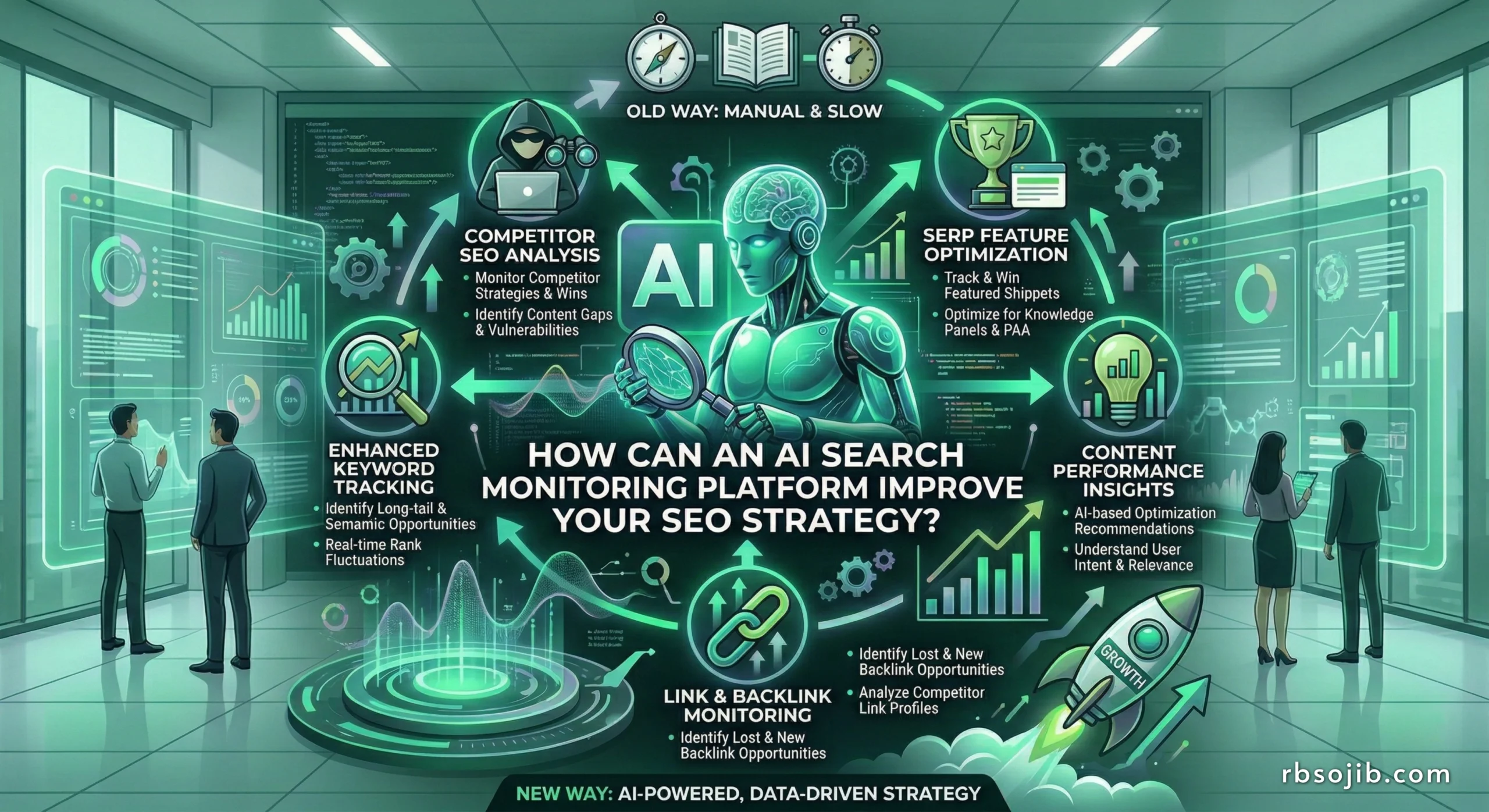
The digital landscape of 2026 is unrecognizable compared to just a few years ago. If you are still managing your search presence using only traditional spreadsheets and monthly ranking reports, you are likely falling behind. Search is no longer just a list of “blue links.” Today, we live in the era of AI Overviews, conversational search agents like Gemini and ChatGPT, and zero-click results that provide answers before a user even visits a site.
In this fast-paced environment, staying visible requires more than just good content; it requires a proactive, data-driven approach. This is where AI search monitoring platforms come into play. But how can an AI search monitoring platform improve your SEO strategy in a way that manual efforts simply cannot?
In this comprehensive guide, we will explore why AI search monitoring is the new backbone of a successful SEO strategy, how it provides deep search ranking insights, and the specific ways it can transform your organic performance.
What is an AI Search Monitoring Platform?
Before we dive into the “how,” let’s define the “what.” An AI search monitoring platform is a sophisticated software solution that uses machine learning and natural language processing (NLP) to track, analyze, and predict your website’s performance across various search engines and AI-driven discovery platforms.

Unlike traditional search monitoring software that might only check your rank for a specific keyword once a day, AI-powered SEO tools do the heavy lifting of interpreting why those rankings changed. They look at trillions of data points—from algorithm updates to competitor content shifts—and provide actionable advice.
Key Features of AI Search Monitoring:
-
Predictive Data Analysis: These tools don’t just show you past performance; they use AI SEO tools to forecast future trends.
-
Automated Trend Detection: They identify emerging topics before they become high-competition keywords.
-
Natural Language Understanding: AI platforms understand user intent, helping you see if your content actually answers the questions people are asking.
-
Omnichannel Visibility: They track your brand’s presence not just on Google, but within AI chatbots, Reddit threads, and niche forums that influence search results.
Why SEO Professionals Need AI Search Monitoring
The days of “set it and forget it” SEO are over. Modern SEO monitoring is a 24/7 job because search engines themselves are now powered by complex AI models. Manual tracking is not only exhausting; it’s often inaccurate.
The Problem with Manual Monitoring
If you have 500 keywords, checking them manually once a week takes hours. By the time you spot a drop in rankings, your competitor has already stolen your traffic. Without real-time SEO insights, you are essentially driving a car by looking through the rearview mirror.
The Cost of Missed Opportunities
Imagine a new industry trend starts bubbling up on social media and Reddit. Traditional tools might not show search volume for that trend for another month. An AI search monitoring platform detects those linguistic shifts immediately, allowing you to create content while the “keyword difficulty” is still low. This is the difference between leading the market and chasing it.
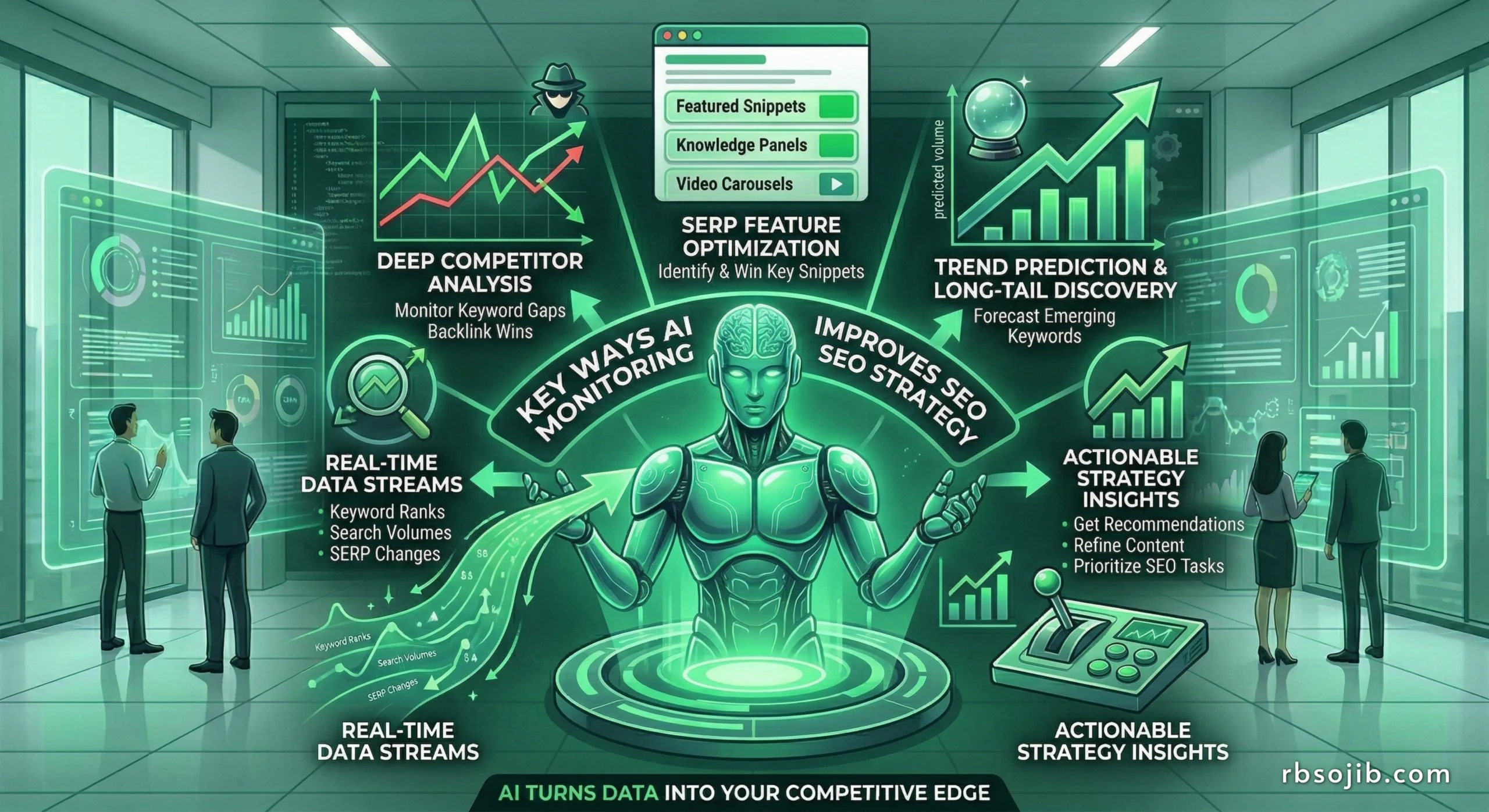
Key Ways AI Search Monitoring Improves SEO Strategy
Integrating AI into your workflow isn’t just about efficiency—it’s about gaining a competitive edge. Here is how can an AI search monitoring platform improve your SEO strategy across five critical areas of digital marketing.
1. Enhanced Keyword Tracking and Intent Mapping
Traditional tracking tells you that you’re #4 for “best running shoes.” AI SEO tools tell you that you’re losing ground because your content focuses on “price” while the current search ranking insights show that users are now searching for “durability.”
-
Automatic Fluctuations Tracking: AI monitors your rankings in real-time. If a page drops three spots, the system can immediately analyze the new top-ranking pages to see what they have that you don’t.
-
Long-Tail Discovery: AI excels at finding “semantic clusters”—groups of related long-tail keywords that build your topical authority.
2. Deep-Dive Competitor SEO Analysis
In 2026, your competitors aren’t just other websites; they are also the AI models themselves. An AI platform allows for advanced competitor SEO analysis by tracking where your rivals are being cited in AI-generated answers.
-
Gap Identification: AI can scan a competitor’s entire sitemap and compare it to yours in seconds, highlighting the exact topics they are winning on.
-
Strategic Reverse-Engineering: If a competitor suddenly spikes in traffic, AI search monitoring can pinpoint whether it was due to a new backlink, a content refresh, or a shift in how Google interprets their brand authority.
3. SERP Feature Optimization
Ranking #1 is great, but appearing in a Featured Snippet or an AI Overview is often better. These “zero-click” features capture the majority of user attention.
-
Tracking SERP Features: AI tools track when you win or lose a “People Also Ask” box or a Knowledge Panel.
-
Optimization Recommendations: The platform can suggest specific formatting changes—like adding a table or an FAQ schema—to help you grab those high-visibility spots. This is a core part of SEO strategy optimization.
4. Content Performance and Semantic Relevance
Content is still king, but “AI-ready” content is the emperor. To improve your SEO strategy, you need to know if your writing aligns with how search engines understand topics today.
-
Content Gap Analysis: AI identifies “missing pieces” in your articles. For example, if you write about “how to bake bread,” AI might suggest you’re missing a section on “altitude adjustments,” which is a common sub-query.
-
Conversion Attribution: Advanced SEO analytics within these platforms can link specific keyword rankings directly to revenue, helping you prioritize content that actually makes money.
5. Link and Backlink Monitoring
Backlinks remain a primary ranking factor, but their quality is now judged by AI-driven sentiment analysis.
-
Real-time Alerts: Get notified the second a high-authority site links to you—or when a toxic link appears that might trigger a penalty.
-
Outreach Intelligence: AI search monitoring can identify which websites are most likely to link to your content based on their current citation patterns, making your link-building efforts far more successful.
How to Integrate AI Search Monitoring into Your SEO Workflow
Adopting new technology can be intimidating. However, the transition to AI SEO integration should be seen as an evolution, not a replacement of your current skills.

Step 1: Selection and Setup
Choose a platform that offers more than just rank tracking. Look for tools that provide actionable SEO insights. Once you’ve selected a tool, input your core “money keywords” and your top 5 business competitors.
Step 2: Automated Workflow Setup
Configure the platform to send you “Anomalous Change” alerts. Instead of checking a dashboard daily, you only step in when the AI detects a significant shift in the search ranking insights that requires human intervention.
Step 3: Analyze and Iterate
Use the AI-generated “Content Briefs” to update old posts. The tool might tell you, “This post from 2023 is losing relevance because it lacks structured data.” This allows for SEO workflow automation, where you spend less time digging for data and more time fixing problems.
The Role of Human Expertise
Remember, AI provides the “what” and the “how,” but humans provide the “why.” Use the AI SEO benefits to handle the data crunching, while you focus on brand voice, creative storytelling, and high-level business strategy.
Case Study: AI Search Monitoring in Action
Let’s look at a real-world example of how these tools move the needle.
The Client: A mid-sized B2B SaaS company struggling to grow their organic traffic despite publishing weekly blog posts.
The Strategy: They implemented an AI search monitoring platform to perform a total audit of their existing content. The AI discovered that while they were ranking for high-volume keywords, their “Click-Through Rate” (CTR) was 40% lower than the industry average because their meta-descriptions didn’t match the “user intent” of the new AI-driven SERPs.
The Results:
-
Ranking Improvements: Within three months, they secured 15 new Featured Snippets.
-
Traffic Growth: Organic traffic increased by 65% as the AI identified “untapped” long-tail keywords with zero competition.
-
Improved Search Rankings: By following the AI’s “Internal Linking” suggestions, they moved five “Page 2” keywords to the top of “Page 1.”
Common Mistakes to Avoid with AI Search Monitoring
Even the best tools can fail if used incorrectly. To get the most out of your SEO strategy, avoid these common AI monitoring pitfalls.
-
Over-Reliance on the “Robot”: AI can hallucinate or misinterpret a sudden spike in “bot traffic” as a genuine trend. Always verify significant data shifts with a second source like Google Search Console.
-
Ignoring User Intent: Sometimes an AI SEO tool will tell you to add a keyword 10 times. If that makes the writing sound robotic, don’t do it. SEO best practices always prioritize the human reader over the algorithm.
-
Treating AI as a “Quick Fix”: SEO is a marathon. An AI search monitoring platform provides the map, but you still have to run the race. Expecting “instant #1 rankings” is one of the most common SEO mistakes.
Conclusion
The question is no longer “should you use AI?” but rather, “how can an AI search monitoring platform improve your SEO strategy today?”
By automating the tedious parts of SEO monitoring, uncovering hidden competitor SEO analysis data, and providing real-time SEO insights, these platforms allow you to work smarter, not harder. They bridge the gap between “guessing” what search engines want and “knowing” exactly what your audience is looking for.
As we move deeper into 2026, the companies that thrive will be those that embrace AI SEO integration. Start small, choose the right search monitoring software, and let the data guide you toward a more dominant, visible, and profitable search presence.
Are you ready to stop chasing the algorithm and start leading it? The future of your SEO strategy starts with the right AI partner.
How has the rise of AI-generated search results changed your approach to content creation this year?
Comment on your opinion.
I like the efforts you have put in this, regards for all the great content.
Awesome! Its genuinely remarkable post, I have got much clear idea regarding from this post